
Product
Product
Supplier
Search
Get Quote
730 people are quoting

This high-performance POM-C sheet for precision engineering is extruded from 100% virgin copolymer polyoxymethylene resin and then planed and stress-relieved, so it machines flat and stays flat. POM-C sheet is what most machinists call acetal, and it occupies the practical middle ground between easy cutting and serious mechanical strength, which is why it ends up in gear blanks, fixture plates, wear pads and valve bodies rather than in a catalogue of maybe-materials.
What decides whether a precision part passes inspection is rarely the number printed on a datasheet. It is thickness consistency across the sheet, flatness once the part is cut free of the parent plate, and whether the part still measures the same three weeks later in a humid workshop. Water absorption of this POM-C plastic plate stays near 0.2% at saturation, so a machined component holds its dimensions in conditions where a nylon equivalent would already have swollen past tolerance.
Each sheet leaves the plant with a batch reference that traces back to the incoming resin inspection record. When a drawing calls out plus or minus 0.05 mm over 200 mm, that traceability is what lets a machine shop defend the part in a customer audit instead of re-cutting it.

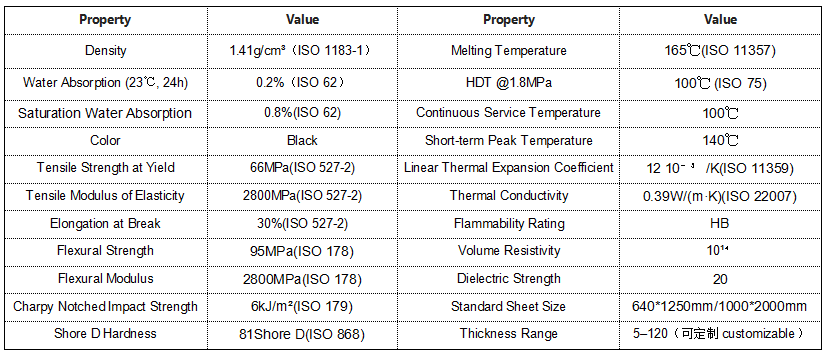
The excellent wear resistance of POM-C sheet comes from the crystalline structure of the polymer itself, not from a surface treatment that wears through after a few thousand cycles. A friction coefficient of 0.2 to 0.35 against dry steel, paired with better heat dissipation than most engineering plastics, lets a bushing or wear strip run without grease and without the adhesive pickup that softer materials develop under the same load.
Wear rate is never one number, though. It moves with the surface finish of the mating steel, with ambient temperature, and with whether abrasive dust is present. Where the limiting factor is pressure multiplied by velocity rather than impact, a glass-filled or PTFE-modified grade raises the usable PV envelope considerably, and both are produced on the same extrusion line as the standard sheet.
Send us the load, the sliding speed and the duty cycle and we will recommend a grade rather than simply the thickest plate in the warehouse. That conversation usually saves more money than a discount on the material.

POM Board in High Durability Applications
In high durability applications, POM board earns its place by outlasting the parts around it. These are components that see millions of small cycles instead of one large load, where a failed piece means an unplanned line stop rather than a maintenance ticket.
Because the same polyoxymethylene sheet is available in black, white, natural and colour-matched form, one production line can colour-code its wear parts without changing material or machining parameters. Maintenance teams tend to appreciate that more than any datasheet improvement.
Machining and Fabrication Notes
POM-C behaves closer to c to most plastics on a machine tool: free-cutting, clean chips, no coolant strictly required. A few habits shorten the learning curve.

If you are interested in the product, contact 2bvideo.com for more information for more information
The information of 2bvideo.com limited shown above is provided by the user or collected on the network. Video 2B does not guarantee the authenticity,accuracy and legitimacy of 2bvideo.com limited information. Video 2B does not involve legal relationships and disputes between users arising from transactions other than secured transactions on this website. Disputes shall be settled by you through negotiation. If you are the person in charge or relevant employee of this enterprise, if you find that the enterprise information is incorrect or want to manage thiscompany, please contact us jacklee1558@gmail.com, after you claim the enterprise, you can obtain management permission, publish supplyand demand information, bring consulting orders, and remove page advertisements.
Main Product:
peek sheet,
pom sheet,
pa sheet,
peek rod,
pom rod,
pa rod


