
Product
Product
Supplier
Search
Get Quote
730 people are quoting

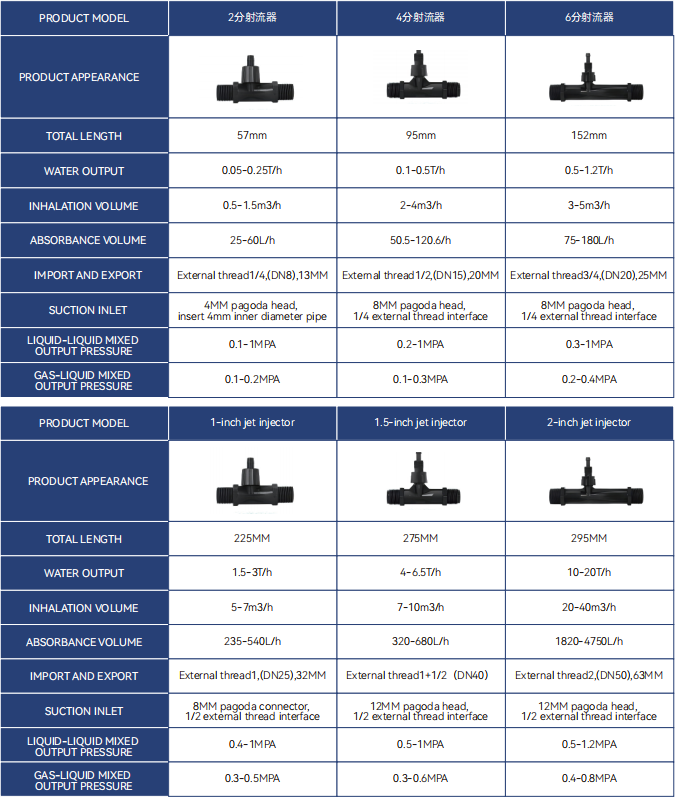
This is our biggest injector. We made it for big jobs like city water plants and factory wastewater systems. The 2 inch model handles 10 to 20 tons of water per hour.
Here is how it works. Water goes through the injector. Inside there is a narrow part. When water speeds up through that narrow part, it creates a vacuum. That vacuum pulls ozone gas into the water. No moving parts. Simple. Reliable.
We use PVDF plastic for this injector. Why PVDF? Because ozone eats through most materials. Metal rusts. Regular plastic gets brittle and cracks. PVDF just sits there and works. We have customers running these things for 5 to 8 years without any problems.
This is one of our Venturi Injectors that people use for large scale water treatment. It does one job and does it well.
City water plants. They need to kill bacteria in drinking water. Chlorine works but leaves bad stuff behind. Ozone does not. This injector puts ozone into the main water line. No chemicals. No residue.
Power plants. Cooling towers grow slime. Slime makes the system less efficient. It also grows bad bacteria. Ozone stops that. This injector adds ozone to the cooling water. No drums of chemicals to store. No safety suits to wear.
Factories. Dye houses. Paper mills. Chemical plants. Their wastewater stinks. It has color. It has high COD. Ozone breaks that stuff down. This injector gets the ozone into the water so the reaction can happen.
Anyone building Venturi Injectors for Ozone systems for industrial use ends up looking at this size eventually.
| What | The number |
|---|---|
| Water flow | 10 to 20 tons per hour |
| Ozone suction | 20 to 40 cubic meters per hour |
| Liquid draw | 1820 to 4750 liters per hour |
| Connections | 2 inch male thread (DN50) |
| Suction port | 12mm barb |
| Pressure for water mixing | 0.5 to 1.2 MPa |
| Pressure for gas mixing | 0.4 to 0.8 MPa |
| Material | PVDF body |
| Length | 295mm |
I have helped customers install these for years. Here is what I tell them.
First, check your water flow. This injector needs 10 to 20 tons per hour. Too little flow and you get no vacuum. Too much flow and your pump works too hard.
Second, your pump needs enough pressure. For mixing ozone into water, you want 0.5 to 1.2 MPa at the injector. That is about 70 to 170 psi.
Third, put a check valve on the suction line. If you do not, water flows back into your ozone generator and kills it. I have seen this happen more times than I can count.
Fourth, look for the arrow on the injector body. Point it downstream. The injector works in any orientation.
Fifth, connect your ozone generator to the suction port. Use tubing that fits the 12mm barb. PTFE tubing is best.
Sixth, give the ozone time to work. For killing germs, 2 to 10 minutes is fine. For breaking down chemicals, you might need 15 to 30 minutes. Use a tank or a long pipe after the injector.
When you design Ozone Venturi Mixers systems, the injector is just one piece. The contact time matters just as much.
Ozone suction is weak. Check your water pressure first. Low pressure means low vacuum. Also check for dirt in the throat. Scale builds up over time. Soak the injector in vinegar or citric acid to clean it out.
No suction at all. Either the throat is completely blocked or you put the injector in backward. Look at the flow arrow.
Water going back to the ozone generator. Your check valve failed. Replace it. Maybe put two check valves in series if you want to be safe.
Pressure drop too high. Your pump is too small. Or you are pushing too much water through the injector.
These are common issues with Venturi Ozone Systems. Most of them are easy to fix once you know what to look for.
Q: How much ozone can this handle?
A: PVDF works with ozone up to about 200 to 300 grams per cubic meter. Need higher? Call us. We can talk about other materials.
Q: How much pressure will I lose?
A: At full flow, about 0.1 to 0.3 MPa. That is 15 to 45 psi. Make sure your pump can handle it.
Q: Can I use this for oxygen or just ozone?
A: Works for any gas. Oxygen. Air. Whatever you need.
Q: What maintenance does it need?
A: Not much. Check the suction port once a month. Clean the throat if performance drops. Change the seals every 2 or 3 years. That is it.
Q: Do you make custom sizes?
A: Yes. We have been making Ozone System Parts since 2011. Custom flows. Custom connections. Custom materials. Send us your specs.
We started making ozone equipment in 2011. Our factory is 6000 square meters. Almost 40 patents. Customers in over 130 countries.
CE. FCC. EPA. Health Commission license. One year warranty. Lifetime support.
But honestly? Customers come back because our stuff works. And when something breaks, we actually answer the phone.
If you need Venturi Injectors for a big project, give us a call. We will help you size it right.
If you are interested in the product, contact 2bvideo.com for more information for more information
The information of 2bvideo.com limited shown above is provided by the user or collected on the network. Video 2B does not guarantee the authenticity,accuracy and legitimacy of 2bvideo.com limited information. Video 2B does not involve legal relationships and disputes between users arising from transactions other than secured transactions on this website. Disputes shall be settled by you through negotiation. If you are the person in charge or relevant employee of this enterprise, if you find that the enterprise information is incorrect or want to manage thiscompany, please contact us jacklee1558@gmail.com, after you claim the enterprise, you can obtain management permission, publish supplyand demand information, bring consulting orders, and remove page advertisements.
Main Product:
Ozone generator machine,
Ozone generator for water treatment,
Ozone air purifier,
Oxygen source ozone generator ,
Air purifier,
Water-cooled ozone generator


