Core Product Features
1. Material and Craftsmanship
Mainstream commercial products are divided into two types: 201 stainless steel and 304 stainless steel. Cost-effective models are mostly made of 201 stainless steel to meet ordinary cleaning needs; for food and catering scenes with high requirements for hygiene and corrosion resistance, food-grade 304 stainless steel is preferred. It has stronger resistance to oil, moisture, rust and corrosion, and meets the hygiene standards of the catering industry.
The whole sink is formed by integrated stretching process, there is no weld dead corner on the tank body, which is not easy to accumulate dirt. The panel thickness is mostly 0.8mm-1.2mm, and the frame is supported by thickened stainless steel square tubes, so the structure is stable. It will not deform when used with water for a long time. The welding joints are passivated and polished, smooth and burr-free, which is very convenient for daily cleaning and disinfection.
2. Structural Design
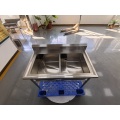
The double-tank independent partition design realizes separation of washing and rinsing: one tank is used for cleaning ingredients and tableware, and the other is used for rinsing. Different cleaning operations can be carried out at the same time, which greatly improves the cleaning efficiency of commercial kitchens and avoids cross-contamination, meeting the catering hygiene specifications.
It is equipped with a complete set of stainless steel faucet and drainage fittings, reserves standard water inlet and drainage interfaces, and is easy to install. The bottom is equipped with adjustable stainless steel feet, which can adapt to uneven kitchen ground and ensure the stable placement of the sink. Some models can be added with a drainage board on the side to place cleaned tableware and ingredients, expanding the use space.
3. Specification Customization
The size range of conventional finished products: the overall length is 1000mm-1800mm, the width is 600mm-700mm, the total height is 800mm-850mm, and the size of a single tank is mostly 500×500×300mm. Conventional optional sizes: 1200/1500/1800*700*800+150mm. It also supports customizing different sizes according to the kitchen space to adapt to different site layouts.
Application Scenarios
Commercial restaurant kitchens: Handle ingredient cleaning and tableware cleaning separately to meet the cleaning requirements of daily catering operations.
Hotels and school canteens: Adapt to mass ingredient pre-treatment and tableware cleaning, and double-tank operation improves cleaning efficiency.
Food processing plants: Used for raw material cleaning and pre-treatment, easy to clean and disinfect, meeting the hygiene requirements of food production.
Bakeries and milk tea shops: Clean tools and ingredients, and the use of separate double tanks avoids cross-contamination, meeting the specifications of beverage and food production.
Technical Parameters
Optional Materials: 201 stainless steel / Food-grade 304 stainless steel
Panel Thickness: 0.8mm–1.2mm
Frame Structure: Thickened stainless steel square tube support, stable and durable
Tank Craft: Integral stretching molding, no welding dead corners
Single Tank Size: 500×500×300mm (conventional)
Conventional Optional Sizes: 1200/1500/1800*700*800+150mm (Customizable)
Basic Size Range: Length 1000–1800mm, Width 600–700mm, Height 800–850mm
Structural Features: Double-tank separate washing & rinsing design, complete water supply & drainage accessories, adjustable bottom feet, optional side drain board
Installation Instructions
Select a flat, dry and well-drained ground for installation. Check the sink body, support frame, stainless steel faucet, drainage pipeline and adjustable feet to ensure complete accessories and no damage. Assemble the bottom support frame first, install and level the adjustable stainless steel feet to keep the overall sink stable. Place the double-tank sink body in position, connect the reserved water inlet and drainage interfaces, and install the faucet and drainage fittings firmly. Check the water tightness of all connecting parts, test the water flow and drainage effect, and confirm no water leakage before formal use.
Usage Instructions
Make full use of the double-tank separated structure during use, strictly distinguish between washing tank and rinsing tank to avoid cross-contamination. Do not impact the tank body violently or place overweight sharp objects on the sink panel to prevent structural deformation and surface scratch. Keep the drainage pipeline unobstructed during daily cleaning, and clean up residual food residues in time to avoid pipeline blockage. Regularly check the tightness of water pipes and joints to prevent water leakage.
Cleaning and Maintenance
Wipe the stainless steel sink surface and tank body regularly with a soft cloth and neutral detergent to remove oil stains, water stains and residues. Do not use strong acid and alkali cleaners or hard cleaning tools to avoid scratching and corroding the surface. The integrated stretching structure has no sanitary dead corners, which is convenient for daily disinfection and cleaning. Regularly check the drainage system and bottom support structure, clean up pipeline dirt, and adjust the foot level in time if the sink is unstable.
Safety Precautions
It is prohibited to impact, squeeze or place heavy objects on the sink for a long time to avoid deformation and water leakage. Do not disassemble the water inlet and drainage structure arbitrarily, so as not to affect the waterproof and drainage performance. In case of pipeline blockage or water leakage, stop using it in time for inspection and maintenance. Keep the ground dry around the sink to prevent slipping accidents. Avoid high-temperature open fire baking near the stainless steel sink.



