Product Introduction
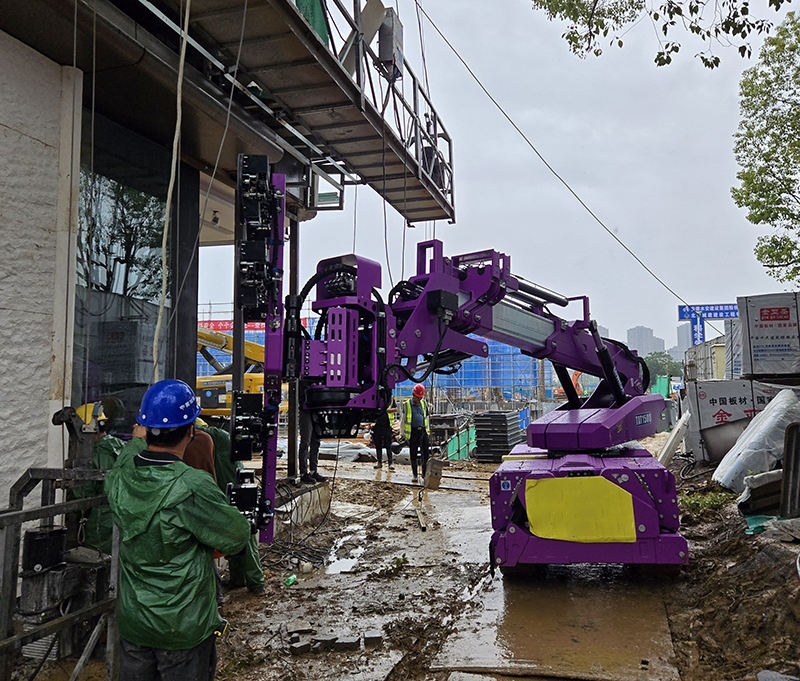
The TAT-1500 is a tracked glazing robot built as a platform rather than a fixed machine. The carrier, the boom, the flying boom and the attachment head are separate modules, and one carrier is documented in three configurations: 8660mm, 11800mm and 12370mm working height.
On the standard three-stage boom with the suction cup head it lifts up to 1500kg to 8660mm for low-rise and mid-rise facade work. Adding the hydraulic flying boom raises the machine to 11800mm with a winch or fork head at 400kg to 3100kg for heavy panel and unitised facade, or to 12370mm with the suction cup head fitted at the end of the flying boom at 250kg to 600kg for high-level curtain wall, because the extended boom puts more moment on the load.
The boom extends in three stages with a 113° stowed angle for transport, and rated load falls stepwise as the boom extends and the working radius grows. Every figure is plotted on the load curves published with the machine, as working height against load and as load against working radius, so any panel weight and reach can be matched to a machine position before you order.
Eight 400mm suction cups run on independent vacuum circuits, so one leaking seal does not drop the whole panel. The boom and the suction frame each rotate 360° independently. A 51.2V 173Ah×4 LFP battery pack gives 6-8 working hours per charge, and every movement is electric and wireless remote controlled, so the operator never stands under the glass.
Product Parameters
TAT 1500 Technical Data
| Max. lifting height |
8660mm |
Max. load capacity |
1500kg |
| Max. horizontal outreach |
6200mm |
Boom extension |
3 stages × 1200mm |
| Selfweight |
7110kg |
Rated power |
14.5kw |
| Driving wheel |
Continuous Track |
Uphill capability |
15% |
| Min. dimensions (L×W×H) |
4475×1480×2336mm |
Stowed boom angle |
113° |
| Batteries |
LFP 51.2V 173AH*4 |
Charging power |
AC220V / 110V~240V |
| Max. working time |
6-8h |
Suction cup |
Dia. 400mm*8 |
| Vacuum system |
Vacuum per suction |
Alert indication |
Light and acoustic |
| Rotating degree |
360° endless (suction frame) |
Arm rotating degree |
360° (boom) |
| Tilting degree |
0-180° |
Side shifting |
150mm |
| Side turning |
90° on both sides |
Up & down shifting |
100mm |
Configuration and Load Curve
| Item |
Config. A suction head on standard boom |
Config. B winch/fork head on flying boom |
Config. C suction head at flying boom end |
| Max. working height |
8660 mm |
11800 mm |
12370 mm |
| Load range on curve |
1500→1000kg by boom stage
3307→2205 lbs |
400–3100 kg
882–6834 lbs |
250–600 kg
551–1323 lbs |
| Load vs. working radius |
see 3-stage curve |
3980mm→960kg; 5180mm→740kg; 6380mm→600kg; 7580mm→500kg; 8580mm→450kg; 9580mm→400kg |
8130mm→500kg; 9130mm→350kg; 10130mm→250kg |
| Head fitting position |
Directly on the boom |
On the flying boom |
At the end of the flying boom |
| Attachment head |
8 × 400mm suction cups on independent circuits |
Winch or fork head |
8 × 400mm suction cups on independent circuits |
| Source |
Brochure 2026 p.17 |
Load curve drawing 002JSWM, 2024/3/4 |
Load curve drawing 002JSWM, 2024/3/4 |
Product Features
1. Modular platform, not a fixed configuration. One carrier gives three working heights: 8660mm at up to 1500kg with the suction cup head on the standard three-stage boom; 11800mm at 400–3100kg with a winch or fork head on the hydraulic flying boom; and 12370mm at 250–600kg with the suction cup head fitted at the end of the flying boom. The attachment head and the flying boom are separate modules, so the machine is specified for the job instead of being ordered as a fixed package.
2. Published load curves for every configuration, and a 113° stowed boom angle. Capacity is stated as working height against load, and load against working radius, rather than as one headline figure, so the rating for your own panel weight and reach can be confirmed from the curve before you order.
3. Two independent 360° rotations. The boom turns through a full circle to put the arm head over the opening, and the suction frame turns through a full circle to bring the panel square to the facade angle. Because the two are separate controls, one operator can go from picking a panel off the stillage to setting it into a facade opening in one continuous movement, without repositioning the machine or lowering the load. Most competing machines offer only one of the two.
4. Three-stage extension boom, 3×1200mm, reaching 6200mm horizontally and 8660mm vertically on the suction cup configuration, covering a full storey and the balcony overhang from one machine position.
5. Stepwise load capacity on the suction cup configuration: 1500kg retracted, 1400kg at first extension, 1000kg at second extension.
6. Eight 400mm suction cups on independent vacuum circuits. Each cup has its own vacuum group, so a single leak is alarmed on that circuit alone instead of releasing the whole panel. Light and acoustic alert indication is standard.
7. Full suction frame articulation: 0–180° tilt, 90° side turn on both sides, 150mm side shift and 100mm up-and-down shift, all electrically operated.
8. Electric, wireless remote control of every movement. Travel, lift, extension, boom rotation, frame rotation, tilt, side shift, side turn and outrigger deployment all run from the handheld unit, so the operator stands clear of the load at all times.
9. Continuous tracks with hydraulic outriggers, 15% gradeability. The outrigiggers level and stabilise the machine before lifting, and the tracks drive it between floors and across site ramps on its own.
Product Summary
The TAT-1500 is built as a platform rather than a fixed machine, and one carrier covers three working heights. On the standard three-stage boom with the suction cup head it lifts up to 1500kg to 8660mm. Add the hydraulic flying boom and the machine works to 11800mm at 400–3100kg with a winch or fork head, or to 12370mm at 250–600kg with the suction cup head fitted at the end of the flying boom. Height and capacity move in opposite directions, so the configuration is chosen by the job rather than by a headline figure. The load curves come with the machine, and we will confirm the rating for your own panel weight and reach and record a video of it. CE certified, one-year warranty including the battery, complete machine with charger and remote control. We are a manufacturer, not a trading company.
FAQ
1. What are the three working heights, and which one do I need?
One carrier covers three, and which one suits the job depends on how high you need to reach and how heavy the panel is. Standard three-stage boom with the suction cup head: 8660mm, up to 1500kg. Add the hydraulic flying boom with a winch or fork head: 11800mm, 400kg to 3100kg for heavy panel, unitised facade and stone. Fit the suction cup head at the end of the flying boom: 12370mm, 250kg to 600kg for high-level curtain wall. The flying boom is an option rather than standard equipment, and we quote all three heights with their load ranges rather than only the highest number.
2. How much glass can it lift at each height?
On the standard boom it is 1500kg with the boom retracted, 1400kg at the first extension and 1000kg at the second extension. On the 11800mm configuration it is 400kg to 3100kg. On the 12370mm configuration it is 250kg to 600kg, and we publish the lowest figure rather than hide it: 500kg at 8130mm radius, 350kg at 9130mm and 250kg at 10130mm. Height and capacity move in opposite directions, because a longer boom puts more moment on the load.
3. Do you publish the load curve? We need to match it to our own panels.
Yes, and the curves come with the machine. They are the manufacturer's load curve drawings, drawing number 002JSWM dated 2024/3/4, plotted as working height against load and as load against working radius, which is why we quote a range rather than a single maximum. Send us the weight, the dimensions and the floor height and we will confirm the rating from the curve and record a video of the machine handling a panel of that specification. If your heaviest panel exceeds the rating at the reach you need, we will tell you rather than quote the nearest one.
4. Can one operator control the whole machine, and how long does the battery last?
Yes. Travel, lift, extension, boom rotation, frame rotation, tilt, side shift, side turn and outrigger deployment are all electric and run from the wireless remote unit, so one operator does the whole job and never stands under or beside the glass. The LFP 51.2V 173Ah×4 pack gives 6 to 8 working hours per charge and charges from AC220V or 110–240V, so it can be recharged between shifts or overnight on site. Each of the eight 400mm suction cups runs on its own vacuum circuit, so a leak is alarmed on that circuit alone and the remaining cups still hold the panel.



