Because PVDF can withstand many acids, oxidizing agents and other industrial chemicals, it is extensively used in chemical-processing equipment and corrosion resistant components. However, it is not universally resistant to all chemicals, concentrations or service conditions.
Before selecting a PVDF rod for a pump, valve or fluid-handling component, determine the chemicals involved, their concentrations, the operating temperature and any pressure or mechanical loads. This information helps to determine if the material is suitable for the intended service.
PVDF generally has higher stiffness and mechanical strength than PTFE, which makes it a good choice for machined parts that must hold their shape under load.
For threaded parts, bores, defined dimensions or specific assembly needs, the material choice should be considered in relation to the operating environment and dimensional requirements of the finished component. The final performance is determined by the material grade, the design and the machining process.
Natural PVDF Plastic Rod can be used as a stock for the manufacturing of custom industrial components. AHD offers CNC Machining, Turning, Drilling and Milling services to discuss projects with specific dimensions or part geometries.
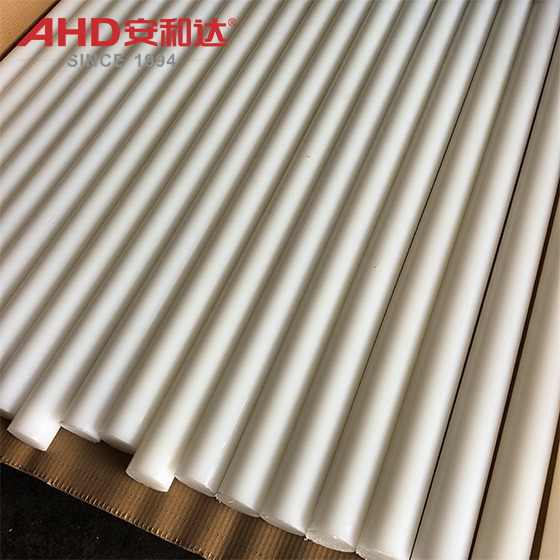
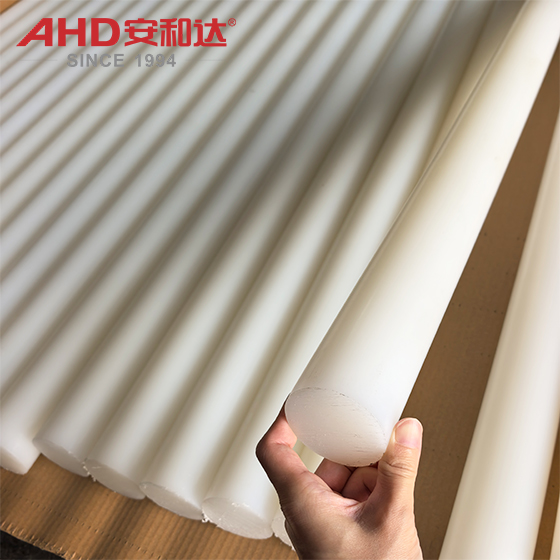
AHD natural PVDF rod is available from 15 mm to 200 mm diameter. Standard length is 1000 mm. Choosing the right starting diameter can help you plan the material usage for turned or milled components.
AHD 55mm Natural White PVDF Rod Checking.
Natural PVDF rod is used in a variety of industrial applications where chemical compatibility and mechanical performance are important.
Chemical equipment components, machined parts for selected chemical-processing environments
Parts for pumps and valves: Parts for fluid handling equipment, tested for chemical and operating conditions.
Machined components for corrosion resistance: custom parts for industrial equipment.
CNC Machined parts: Parts turned, drilled or milled to a drawing.
Parts for industrial equipment: Custom plastic components chosen according to the mechanical and environmental needs of the equipment.
General application categories. Not a guaranty of suitability for all service conditions. If a critical application, check material grade and chemical compatibility before manufacture.
PVDF Rod vs PTFE Rod vs PEEK Rod: Which Should You Choose?
PVDF, PTFE and PEEK are all used in demanding industrial applications but address different material-selection priorities. The right choice depends on operating temperature, chemical exposure, mechanical load, friction requirements, and budget.
| Selection factor |
PVDF Rod |
PTFE Rod |
PEEK Rod |
| Main selection advantage |
Chemical resistance combined with useful rigidity |
Very broad chemical resistance and low friction |
High mechanical performance and high-temperature capability |
| Mechanical behavior |
Generally stiffer than PTFE |
Relatively soft; may deform under sustained load |
Generally strong and rigid |
| Chemical compatibility |
Resistant to many chemicals, but not all |
Very broad resistance; still verify specific conditions |
Good resistance to many chemicals, depending on the medium and conditions |
| Temperature requirements |
Suitable within the selected grade's service limits |
Often preferred when a wider temperature range is required |
Often considered for demanding high-temperature applications |
| Typical selection focus |
Corrosion-resistant components that also need rigidity |
Chemical exposure, low friction or demanding temperature conditions |
High mechanical loads or elevated operating temperatures |
| Relative purchasing cost |
Often a cost-conscious alternative to PEEK |
Depends on grade and form |
Generally a higher-cost engineering plastic |
How to choose:
For a compatible operating environment, select PVDF Rod when chemical resistance and useful mechanical rigidity are required.
If you want the lowest friction possible or a wider range of chemical and temperature resistance, consider PTFE Rod. But keep in mind its tendency to deform under sustained load.
If mechanical performance and higher operating temperatures will justify the higher material cost, look into PEEK Rod.
This guide is a preliminary selection guide and should not be used in place of engineering approval. Properties and cost depend on grade , manufacturer and specification . Prior to completion of your design, review the technical data of the selected material and its compatibility with the actual service conditions.
Natural PVDF Rod Supplier for Wholesale and Industrial Buyers
AHD’s B2B customers include wholesalers, distributors, importers, plastic fabricators, CNC machining companies and factory purchasing teams from all over the world.
Regular specifications are generally in stock and can be dispatched within 48 hours of order confirmation. Please check availability for size and quantity. Requirements for non-stock items follow the applicable production schedule.
AHD can also assist buyers needing machining services or a range of engineering plastic materials. With over 32 years experience in the plastic sheet and rod manufacturing industry, AHD is a practical sourcing option for companies that coordinate material purchasing and component production.
Supported by factory audit reports, SGS reports where applicable, Certificates of Origin and suitable export documentation. Additional third party testing can be discussed by agreement. Please confirm what documents you need for your order?
FAQ about Natural White PVDF Rod
What sizes of natural PVDF rods does AHD offer?
The confirmed diameter range of AHD is 15-200 mm. The standard length is 1000 mm. Please check availability for your size with the sales team.
Q1: Can I get PVDF rod cut to length?
Yes, AHD can cut to length for you. Please provide your required length, diameter and quantity for review and quotation.
Q2: Can AHD produce PVDF components machined on a CNC?
AHD provides CNC machining, turning, drilling and milling services. Send your drawing, dimensions, tolerances and quantity so we can check the requirements for machining.
Q3: Can PVDF rod be used in chemical equipment?
PVDF is typically used in chemical processing and corrosion-resistant applications. However, Compatibility is a function of the specific chemical, concentration, temperature and operating conditions. Check suitability of the material before use.
Q4: What is the difference between PVDF rod and PTFE rod?
PVDF usually has a higher stiffness and mechanical strength than PTFE, but PTFE is often chosen for its very broad chemical resistance and low friction. The 'best' is dependent upon the application and the operating conditions.
Q5: Does AHD do SGS reports and export documents?
Factory inspection report and available SGS documentation can be verified against the specific order. We can also discuss a Certificate of Origin and any export documents that may be required. Other third party testing can be arranged by agreement.
Request a Quote for Natural PVDF Rod
Looking for a reliable Natural PVDF Rod supplier for chemical equipment, pump and valve parts or CNC-machined industrial parts?
Contact AHD with your diameter, length, quantity and destination requirements. If you want finished components attach your technical drawing and state the tolerances you require.
Send your requirements to discuss available sizes, machining options, inspection documents and export arrangements for your order.



