Production Process Step-by-Step Guide:
1. Mold Design and CNC Engraving: Preparation Stage. Convert the 3D CAD model into precision CNC toolpaths. Engrave copper (brass) or aluminum molds. For
full 3D figures, create separate front and rear cavity molds (or split 3D molds) with locating pins and venting channels.
2. Liquid PVC Slurry Preparation: Material Preparation.
Mix liquid PVC slurry (plastic sol) with plasticizer, environmentally friendly stabilizer, and pigments. Remove air bubbles from the liquid using a vacuum degassing machine to prevent pinholes or defects during baking.
3.
Multi-color Dispensing (Micro-injection): First Layer - Fine Details. Using an automated multi-nozzle dispensing machine, precisely inject fine accent colors (eyes, facial features, clothing details, etc.) into the deepest recesses of the mold cavity.
4. Baking and Curing (Pre-gel): Heating 160°C – 280°C. The mold is heated via heating wires (or an oven) to gel the initial detail layer, preventing color bleeding into the next layer. The mold is then rapidly cooled on a water-cooling platform in preparation for the next injection.
5. Substrate Filling and Mold Assembly: Second Layer - Body. The remaining mold cavity space is filled with the body color (or transparent inner core). For 3D figures, the front and rear molds fit tightly together, often with integrated metal rings or hooks for attaching keychains.
6. Final Hot Press Molding and Curing: Hot pressing, cold pressing for shaping, and complete fusion. The assembled two halves of the mold undergo final pressure and heating in a double-sided pressing and molding machine, fusing the liquid plastisol into a strong, elastic, rubbery PVC figure.
7. Demolding: Finished Product Line. The mold is opened, and the soft PVC figure is removed. Excess burrs (overflowing resin) are removed, and keychains, open rings, or metal chains are attached.
Jinyu Machinery TUA supplies one-stop service covering full drop-plastic production: production process, machines, raw materials and molds. Equipment ranges from mixing machine, vacuum defoaming machine, dispenser, baking table to vulcanizer. (Pvc Dispensing Machine,Silicone Dispensing Machine,Automatic Dispensing Machine,Plastic Dispensing Machine, Intelligent Pvc Oven,Intelligent Pvc Baking Machine,Energy-Saving Pvc Oven, Silicone Oven,
China PVC oven,Pvc Logo Making Machine,Pvc Keychain Machine,Pvc Patch Making Machine, and many new machines)
For accurate proportioning, refined formula and consumable cost analysis, feel free to contact Jinyu Machinery.
The parameter of PVC doubel-station oven:
| Name |
PVC/Silicone Oven |
PVC/Silicone Oven |
| Model |
JY-SO3-B-5050-V1 |
JY-SO3-B-4040-V1 |
| Voltage |
380V |
380V |
| Station |
2 |
2 |
| Wore area |
500*500mm |
400*400mm |
| Cooling type |
Water cooling |
Water cooling |
| Total Power |
10.2kw |
10.2kw |
| Size |
1550*1300*1350mm |
1180*1200*1370mm |
| Weight |
400kg |
300kg |
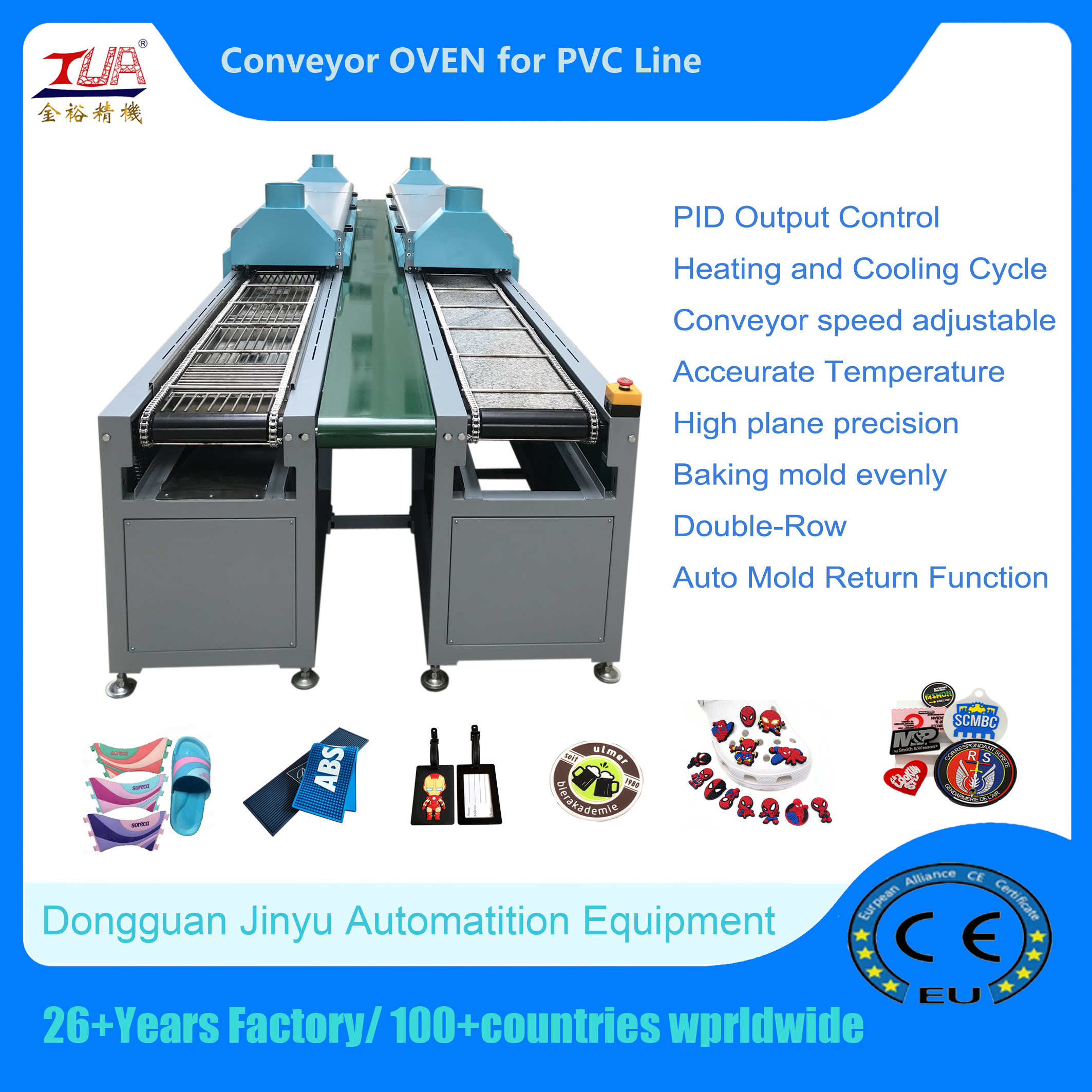
The parameter of PVC conveyor oven:
| Name |
PVC production double line |
3.4m Production line |
1.8m Production line |
| Model |
JY-SO1 |
JY-SO2 |
JY-SO4 |
| Voltage |
380V,3phase |
380V,3phase |
380V,3phase |
| Heating area |
3000*400mm |
2000*300mm |
1000*300mm |
| Cooling area |
1000*400mm |
480*258mm |
|
| Max temp |
400℃ |
400℃ |
400℃ |
| Move speed |
Adjustable |
Adjustable |
Adjustable |
| Cooling type |
Water cooling |
Water cooling |
|
| Total power |
65kw |
21.8kw |
7.4kw |
| Size |
6000*1900*1650mm |
3450*590*1250mm |
1800*530*1250mm |
| Weight |
2500kg |
500kg |
240kg |
Key features of industrial PVC/silicone ovens:
1. Multi-zone temperature control: Independent heating zones: The tunnel oven features 2 to 4 independent temperature zones (e.g., Zone 1 for pre-gelling at 120°C–150°C; Zone 2 for full curing at 180°C–220°C). This prevents surface bubbling or uneven shrinkage. PID digital temperature controller: Temperature is precisely controlled within ±1°C to ±2°C to maintain color vibrancy and prevent scorching.
2. Heating system and heat distribution: Far-infrared (IR) heating tubes/quartz tubes: Infrared heating penetrates directly into the mold cavity and liquid plastisol, achieving rapid and uniform cross-linking without the need for high airflow, avoiding liquid displacement. Hot air circulation: An internal fan redistributes hot air across the entire tunnel width, maximizing energy efficiency and ensuring batch-to-batch curing uniformity.
3. Conveyor and drive mechanism: stainless steel mesh belt: A heat-resistant mesh or chain conveyor belt smoothly transports the mold through the heating chamber. Variable Frequency Drive (VFD): Seamlessly adjustable conveyor belt speed for precise control of baking dwell time (typically 30 seconds to 3 minutes, depending on product thickness).
4. Integrated Cooling and Mold Handling: Post-baking water-cooled or air-cooled zone: Integrated fan units or under-workbench water bath cooling systems rapidly reduce mold temperature after removal from the heating chamber, allowing operators or robotic mold removers to handle molds immediately. Dual-sided/Multi-workbench Layout: Manual or semi-automatic ovens are equipped with an upper heating plate and a lower cooling platform, along with pneumatically driven mold sliding trays to maximize operator ergonomics.
5. Safety and Exhaust Management: Exhaust Port: Dedicated duct ports exhaust plasticizer vapors (DOP/DOTP vapors) generated during heating, maintaining factory air quality and safety standards. Insulation: Rock wool or ceramic fiber insulation jackets retain internal heat, reducing energy consumption and preventing overheating of external cabinet surfaces.