
Product
Product
Supplier
Search
Get Quote
730 people are quoting

Armcoltherm Si-10 a non-volatile Heat Transfer Fluid
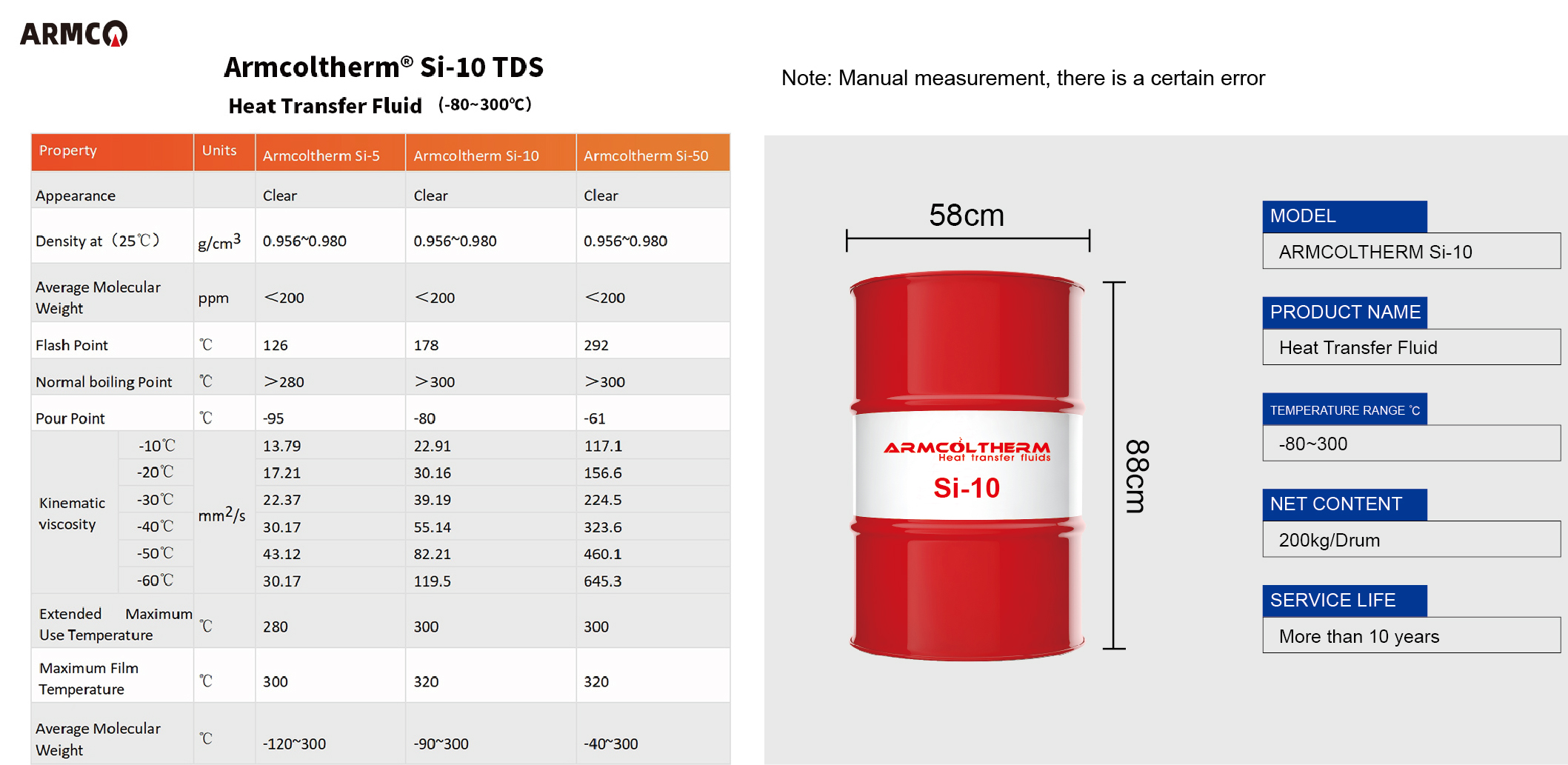
The effectiveness of heat transfer oil is heavily influenced by its viscosity, vapor pressure, boiling range, initial boiling point, and flow point. These crucial properties directly affect the efficiency of heat transfer processes. A lower viscosity enables the oil to flow more smoothly, leading to improved heat transfer efficiency. Heat transfer oil is composed of different components, each having its own boiling point. Consequently, it exhibits a range of boiling points, known as the boiling range. It is important to highlight that a wider boiling range signifies a higher maximum temperature capability for the oil.
Apart from these key factors, there are other significant aspects to consider when evaluating the performance of heat transfer oil. The flash point is an essential characteristic that indicates the temperature at which the oil can ignite when exposed to an open flame or spark. A higher flash point ensures greater safety during handling and operation.
Another crucial consideration is the thermal stability of the heat transfer oil. Over time, thermal degradation can occur due to exposure to high temperatures, leading to the formation of unwanted by-products and a decrease in performance. Therefore, it is important to select a heat transfer oil with excellent thermal stability to ensure long-term efficiency and reliability.
Additionally, the heat transfer oil's thermal conductivity plays a vital role in determining its ability to efficiently transfer heat. Higher thermal conductivity allows for better heat transfer rates, enabling the oil to effectively carry and distribute thermal energy.
Furthermore, the heat transfer oil's resistance to oxidation and corrosion is of utmost importance. Oxidation can result in the formation of sludge and deposits, leading to reduced heat transfer efficiency and potential equipment damage. Similarly, corrosion can cause deterioration of the system, impacting its overall performance. Therefore, choosing a heat transfer oil with excellent oxidation and corrosion resistance is crucial for maintaining optimal heat transfer efficiency and prolonging the lifespan of the equipment.
In summary, the performance of heat transfer oil is influenced by various factors such as viscosity, vapor pressure, boiling range, initial boiling point, flow point, flash point, thermal stability, thermal conductivity, oxidation resistance, and corrosion resistance. Considering these key properties ensures the selection of a heat transfer oil that can effectively and efficiently transfer heat, ensuring reliable and safe operation of heat transfer systems.
If you are interested in the product, contact 2bvideo.com for more information for more information
The information of 2bvideo.com limited shown above is provided by the user or collected on the network. Video 2B does not guarantee the authenticity,accuracy and legitimacy of 2bvideo.com limited information. Video 2B does not involve legal relationships and disputes between users arising from transactions other than secured transactions on this website. Disputes shall be settled by you through negotiation. If you are the person in charge or relevant employee of this enterprise, if you find that the enterprise information is incorrect or want to manage thiscompany, please contact us jacklee1558@gmail.com, after you claim the enterprise, you can obtain management permission, publish supplyand demand information, bring consulting orders, and remove page advertisements.
Main Product:
Heat Transfer Fluid,
Heat Transfer Oil,
Thermal Oil ,
Dibenzyltoluene,
Alkylbenzene,
Hydrogenated Terphenyls


