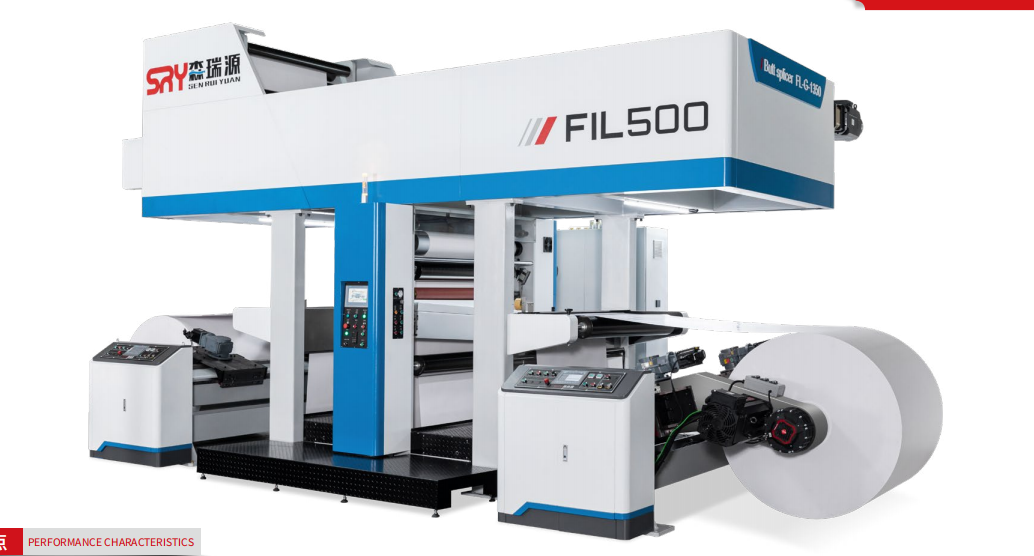
A paper splicing machine is a device used in roll-fed printing and packaging processes to automatically join and switch between an almost depleted old roll and a new standby roll without stopping the production line. Its core functions involve maintaining constant tension and precisely matching the speeds of the old and new paper webs—either at zero speed or synchronized speed—for seamless bonding and cutting.
Core Working Mode
Paper splicing mainly involves two technical approaches, distinguished by whether the old roll is decelerated to a complete stop:
Zero-speed automatic splicing: The old roll is braked to a complete stop, while the new roll remains stationary. Double-sided adhesive bonding and cutting are performed at zero relative speed. A paper storage rack is required to continuously supply paper to the main machine during braking, ensuring high stability. However, this design includes a paper-holding mechanism and is typically used in medium- to high-speed applications or where high registration accuracy is required.
High-speed (in-line) automatic splicing: The new roll is accelerated to match exactly the linear speed of the running old roll (zero relative speed difference), enabling direct splicing and cutting of the old roll during high-speed operation. No paper storage rack is needed, and the printing press runs continuously without deceleration. This method is suitable for ultra-high-speed rotary printing (e.g., newsprint) and demands extremely high precision in sensors, drives, and control systems.
General Workflow (using a typical automatic cycle as an example)
Monitoring and Early Warning: Sensors continuously monitor the diameter of the running roll. When it reaches a preset threshold, a splicing signal is triggered.
Standby Roll Preparation: The new roll is loaded into position, pre-coated with double-sided adhesive tape, and precisely aligned to the splicing station.
Speed Matching:
- Zero-speed mode: The old roll is smoothly decelerated to a full stop using electromagnetic brakes, while the paper storage rack releases stored paper to maintain continuous machine operation.
- High-speed mode: The new roll is accelerated via friction rollers or servo drive until its linear speed perfectly synchronizes with that of the old roll.
Splicing Execution: The splicing arm lowers, pressing the foam roller or pressure roller against the new and old paper webs to firmly bond them together (using the pre-applied adhesive), while the cutting blade instantly severs the trailing end of the old roll.
Switching and Reset: The new roll takes over paper feeding; the old core is ejected or braked to a stop. The splicing arm returns to its initial position, and the system clears fault signals, preparing for the next cycle.
Key Control Systems
Tension Closed-loop Control: Utilizing floating rollers, tension sensors, and PLC/PID algorithms, air brakes or motor torque are dynamically adjusted to minimize tension fluctuations before and after splicing, preventing paper breakage or wrinkling.
Synchronous Drive Technology: High-speed models rely on encoder feedback and servo pre-drive systems to achieve millisecond-level speed tracking and synchronization.
Mechanical Actuation Units: Includes rotating splicing arms, pneumatic compression rollers, precision cutting blades, and claw positioning systems, ensuring accurate splicing alignment.