
Product
Product
Supplier
Search
Get Quote
730 people are quoting

Salicylic Acid 99% TC is a technical-grade plant signaling compound used in agricultural formulations related to plant defense, stress-response management, seed treatment, foliar application, and selected plant tissue culture systems.
Chemically identified as 2-hydroxybenzoic acid, Salicylic Acid is an endogenous signaling molecule involved in multiple plant physiological processes. In agricultural formulation, it is primarily associated with defense signaling, stress-response pathways, seed and seedling regulation, and selected reproductive-stage applications.
The product is supplied as a white crystalline powder and is standardized to an assay of not less than 99% by HPLC. Its melting point is typically specified at 158-161°C, with loss on drying controlled at not more than 0.5%.
Salicylic Acid is only slightly soluble in water but is soluble in, and ether. It also reacts with alkali to form salicylate salts. These physicochemical characteristics should be considered when developing aqueous concentrates, foliar products, or compound biostimulant formulations.
Because plant responses to Salicylic Acid are strongly concentration-dependent, technical formulation and end-use dosage require careful control. Excessive concentrations may suppress growth or cause phytotoxic responses rather than producing the intended regulatory effect.
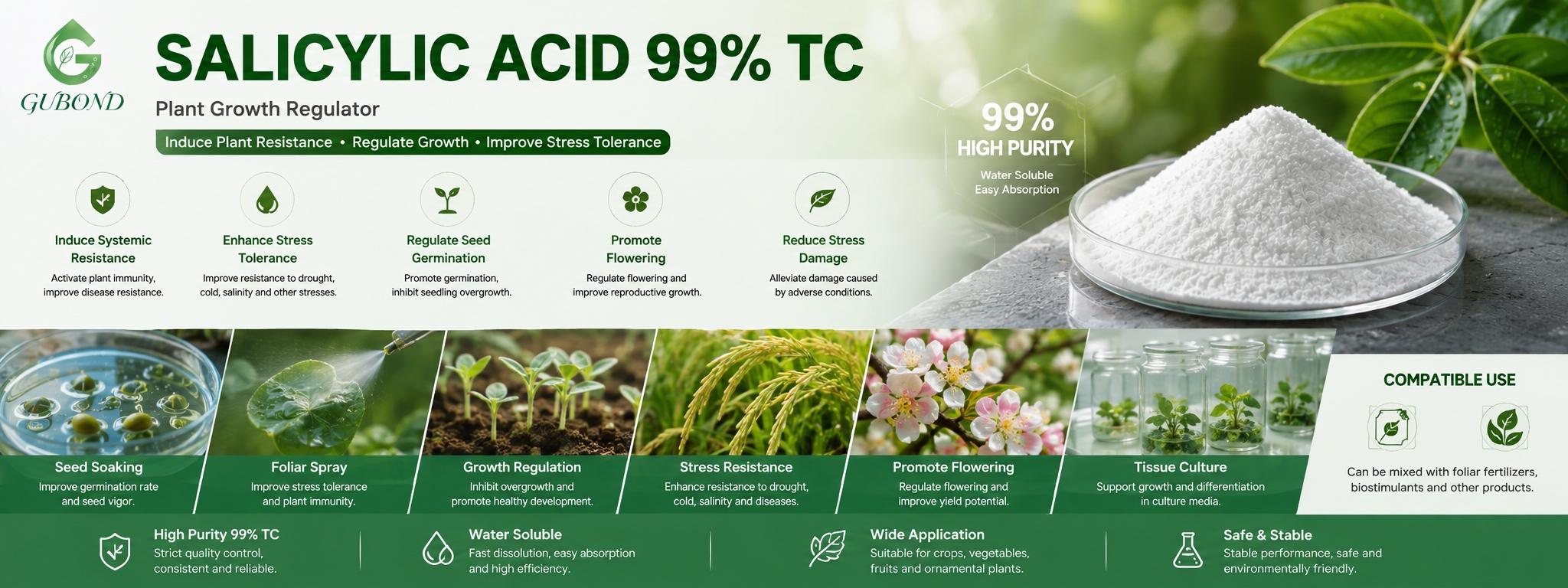
| Parameter | Specification |
|---|---|
| Product Name | Salicylic Acid 99% TC |
| Chemical Name | 2-Hydroxybenzoic Acid |
| Product Type | Plant Stress-Response Elicitor / Plant Growth Regulator |
| Grade | Technical Grade |
| Form | Technical Raw Powder |
| Assay | ≥99% |
| Test Method | HPLC |
| CAS Number | 69-72-7 |
| Appearance | White Crystalline Powder |
| Melting Point | 158-161°C |
| Loss on Drying | ≤0.5% |
| Water Solubility | Slightly Soluble |
| Organic Solubility | Soluble in, and Ether |
| Alkali Reaction | Forms Salicylate Salts |
| Main Applications | Seed Treatment, Foliar Spray, Stress-Management Formulations |
| Additional Application | Plant Tissue Culture |
| Common Combinations | Brassinolide, Seaweed Extract, Foliar Fertilizer |
| Quality Documentation | COA / SDS Available |
| Storage | Cool, Dry, Shaded, and Sealed Conditions |
Salicylic Acid is an important signaling molecule in plant physiology. Its principal technical relevance is associated with regulation of plant defense signaling and responses to environmental or biological stress.
In crop formulations, Salicylic Acid can be used as an elicitor-type component where the objective is to stimulate endogenous plant response pathways rather than directly provide mineral nutrition. This distinguishes it from fertilizers and conventional nutrient ingredients.
The material is also relevant to seed and seedling management. Depending on concentration and crop species, Salicylic Acid may be incorporated into seed-soaking or early-growth formulations designed around germination control and seedling development.
Solubility is a key formulation consideration. Free Salicylic Acid has limited water solubility, so technical powder should not be assumed to dissolve directly in water at useful concentrate levels. Suitable solvents, pH adjustment, salicylate formation, or other formulation methods may be required for water-based products.
Salicylic Acid can be evaluated in compound formulations with brassinosteroid-type PGRs, seaweed extracts, amino acid systems, and foliar fertilizers. Because these ingredients have different physicochemical characteristics, pH, precipitation behavior, storage stability, and dilution performance should be verified.
The active ingredient has a narrow practical concentration window in some crops. Excessive exposure can shift the response from regulation to inhibition, making accurate dosage and homogeneous distribution essential.
Salicylic Acid can be incorporated into agricultural formulations intended to activate or support plant defense-related signaling.
Its use is relevant to programs associated with disease-pressure management and crop physiological readiness. It should not be presented as a replacement for registered fungicides or integrated disease-control measures.
The response depends on crop species, physiological condition, concentration, treatment timing, and environmental factors.
Salicylic Acid is used in formulations associated with crop-management programs under drought, low-temperature, salinity, and related stress conditions.
Such applications focus on physiological regulation rather than direct correction of the stress source. Appropriate irrigation, nutrition, soil management, and crop-protection practices remain necessary.
Formulation concentration and timing should be validated for the target crop because high levels can produce inhibitory responses.
Salicylic Acid can be incorporated into selected seed-soaking and seed-treatment systems.
Depending on crop species and concentration, formulation objectives may include dormancy-related regulation, germination management, and early seedling development.
Uniform active concentration and controlled exposure time are important because seed response can vary substantially between species.
Foliar application is an important route for Salicylic Acid-based crop-management products.
Because of its limited water solubility, a suitable formulation approach should be selected to obtain uniform distribution after dilution. Solution pH, solvent compatibility, surfactant system, and tank-mix behavior should be evaluated.
The active ingredient can also be incorporated into compatible foliar fertilizer or biostimulant products.
Salicylic Acid can be included in selected formulations used during flowering and reproductive development.
Its role in these systems is physiological regulation rather than direct nutrient supply. Application concentration and timing should be evaluated according to crop type, developmental stage, and overall management objectives.
Salicylic Acid can be combined with seaweed extract, brassinolide, amino acid ingredients, and other compatible biostimulant materials.
Such combinations can integrate defense signaling, physiological regulation, and nutritional support within one formulation. However, the final product should be evaluated for pH, solubility, chemical compatibility, and crop safety.
Salicylic Acid can also be used in selected plant tissue culture systems where regulation of stress-response pathways or developmental processes is part of the experimental or propagation objective.
The appropriate concentration depends on species, explant type, culture medium, and interaction with other plant growth regulators.
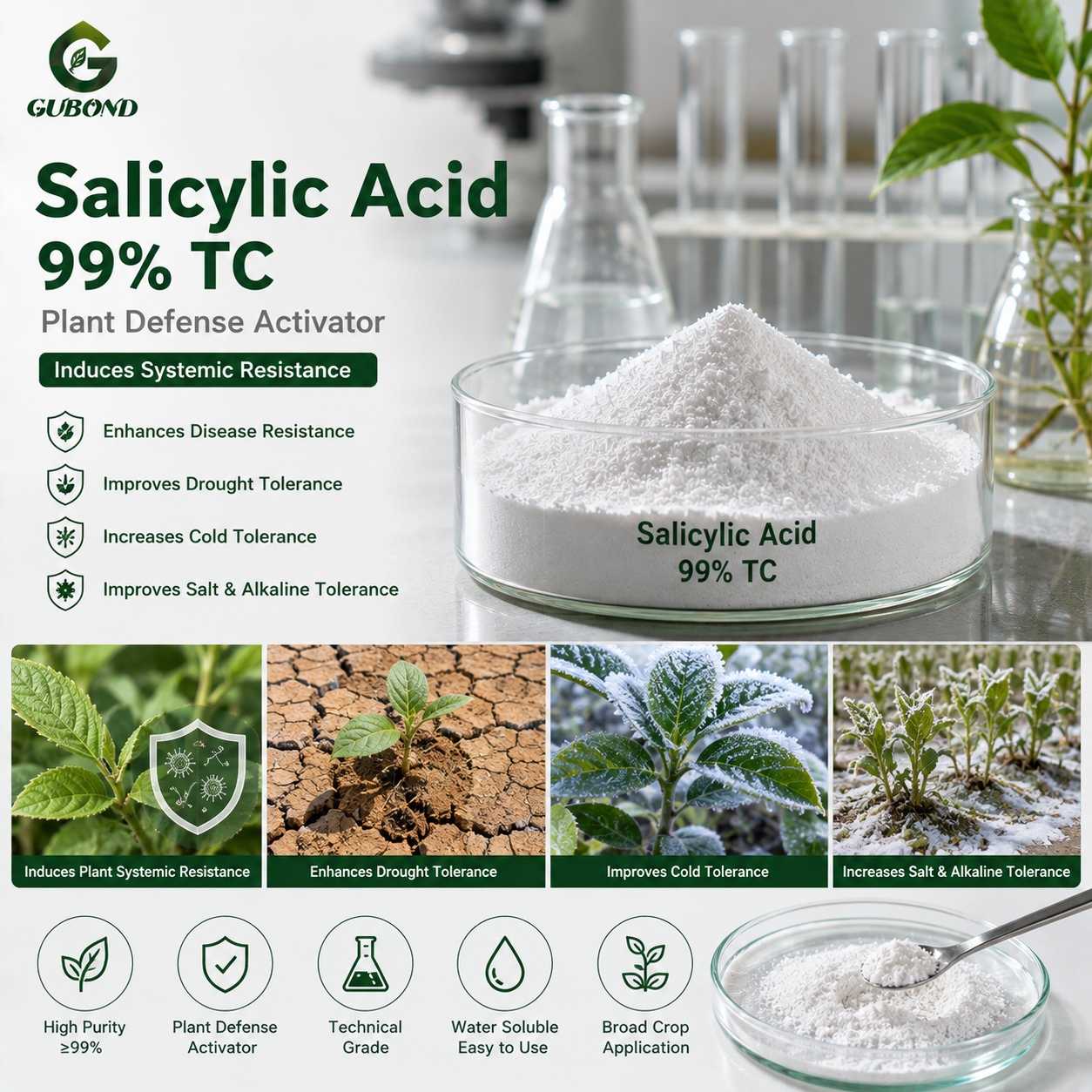
Salicylic Acid 99% TC is standardized to an assay of not less than 99% by HPLC. The technical material is supplied as a white crystalline powder with a melting point specification of 158-161°C and loss on drying of not more than 0.5%.
The active compound is 2-hydroxybenzoic acid, identified by CAS number 69-72-7.
The product is slightly soluble in water and soluble in, , and ether. It reacts with alkaline materials to form salicylate salts, which may provide different solubility characteristics from the free-acid form.
Quality documentation includes a Certificate of Analysis and Safety Data Sheet. Batch-specific assay, melting point, loss on drying, appearance, and other applicable quality parameters should be confirmed against the corresponding COA.
The technical material should be stored in tightly sealed packaging under cool, dry, and shaded conditions.
Salicylic Acid used for agricultural purposes should be formulated and applied according to the regulatory classification of the intended market. Registration, permitted crops, formulation type, application concentration, labeling, and end-use requirements differ among jurisdictions.
If you are interested in the product, contact 2bvideo.com for more information for more information
The information of 2bvideo.com limited shown above is provided by the user or collected on the network. Video 2B does not guarantee the authenticity,accuracy and legitimacy of 2bvideo.com limited information. Video 2B does not involve legal relationships and disputes between users arising from transactions other than secured transactions on this website. Disputes shall be settled by you through negotiation. If you are the person in charge or relevant employee of this enterprise, if you find that the enterprise information is incorrect or want to manage thiscompany, please contact us jacklee1558@gmail.com, after you claim the enterprise, you can obtain management permission, publish supplyand demand information, bring consulting orders, and remove page advertisements.
Main Product:
Raw health products,
Food Additives ,
Cosmetic Raw Materials,
Enzyme Supplements,
Protein Powder,
Health supplements


