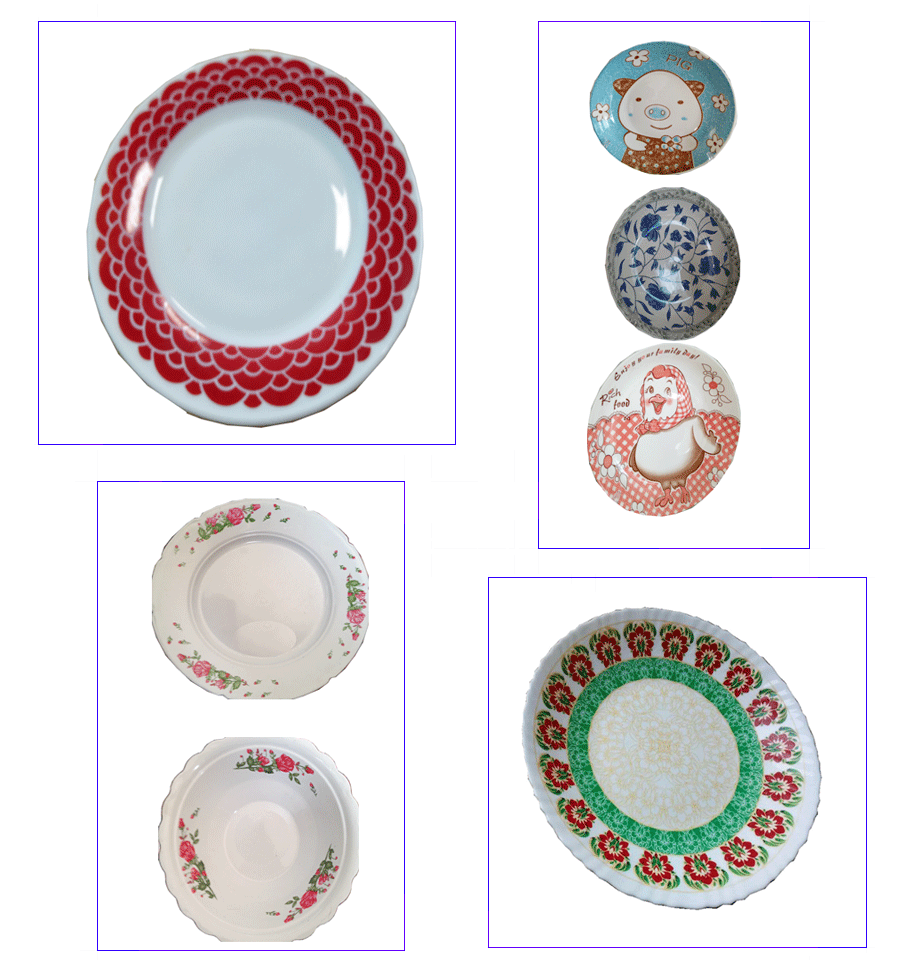
Printed Samples of Ceramic pad printers
Ceramic pad printing machine is a special large-size open pad printer specially designed for ceramic materials such as household tableware. Its maximum steel plate can reach 500*700mm. Considering the deformation of the printed product, users should do a good job of testing. At present, ceramic pad printing machine have single-color, two-color, three-color, and four-color. Considering the precision, most of the pressing down action of pad printing head has been controlled by servo motor. In addition to the single-color ceramic pad printer and the two-color ceramic pad printer, which basically use a splicing workbench, the turntable-type pad printer also uses a turntable-type workbench.
In addition to the large size and high precision requirements of the ceramic pad printing machine, it is important to control the deformation prediction from the steel plate to the product, which requires the coordination of a special plate maker and printing master.
Compared with ordinary pad printing, ceramic pad printing machine may not show advantages. If it is used to print ordinary products, the cost will be high, but as a mechanized printing process transitioned from ceramic decal paper, it is reducing labor costs. The cost has been greatly reduced.
The ceramic pad printer is a large, open-top, dedicated pad printer specifically developed for everyday ceramic products within the pad printing market. It's suitable for complex tableware such as bowls, plates, cups, and teapots. It boasts the largest reported plate sizes on the market (up to 500 x 700 mm). The pad pressure reaches 150 mm or more. Using a very soft or hollow pad, the pad printer offers the ultimate in product shape tolerance.
- The ceramic pad printer utilizes PLC control and servo cylinder drive. Motion accuracy is digitally configured and managed, resulting in clear and precise transfer patterns with a repeatability of within ±0.8 mm.
- It's suitable for products with smooth or uneven surfaces. Ceramic production costs (including pigments and inks) are significantly lower than those of screen printing, hand-spraying, and decals.
- Printing area: Applicable range: 50 mm - 350 mm.
Data of ceramic pad printer
|
Four colors servo 4 Colors rotating open pad printer for tableware //Structure
|
|
Working table
|
16-20 stations rotating working table
|
|
Ink supply system
|
Open inkwell-type system
|
|
Plate type
|
0.5mm Thick steel plate. Size : 500*700mm.
|
|
Pad dropping control
|
Servo motor
|
|
Four colors servo pad printer for tableware //Parameter
|
|
Technical parameters
|
PKC-204SR
|
- Max. plate size: 500×700;
- Max. worktable area: 400×150mm
- Max. printing area: 450×600;
- Max. printing speed: 600-800pcs/h;
- Printable color quantity:4.
- Net weight: 800kg.
|
|
Works supply
|
- 110V-220VPower supply;
- 5-7Bar Compress air;
|
- Package domension: 2.150×2.150×2.580M;
- Gross weight: 1200kg;
- CBM: 4.71495
|
|
H.S.Code
|
8443198000
|
CE
|
Ceramic pad printer Details-advantage
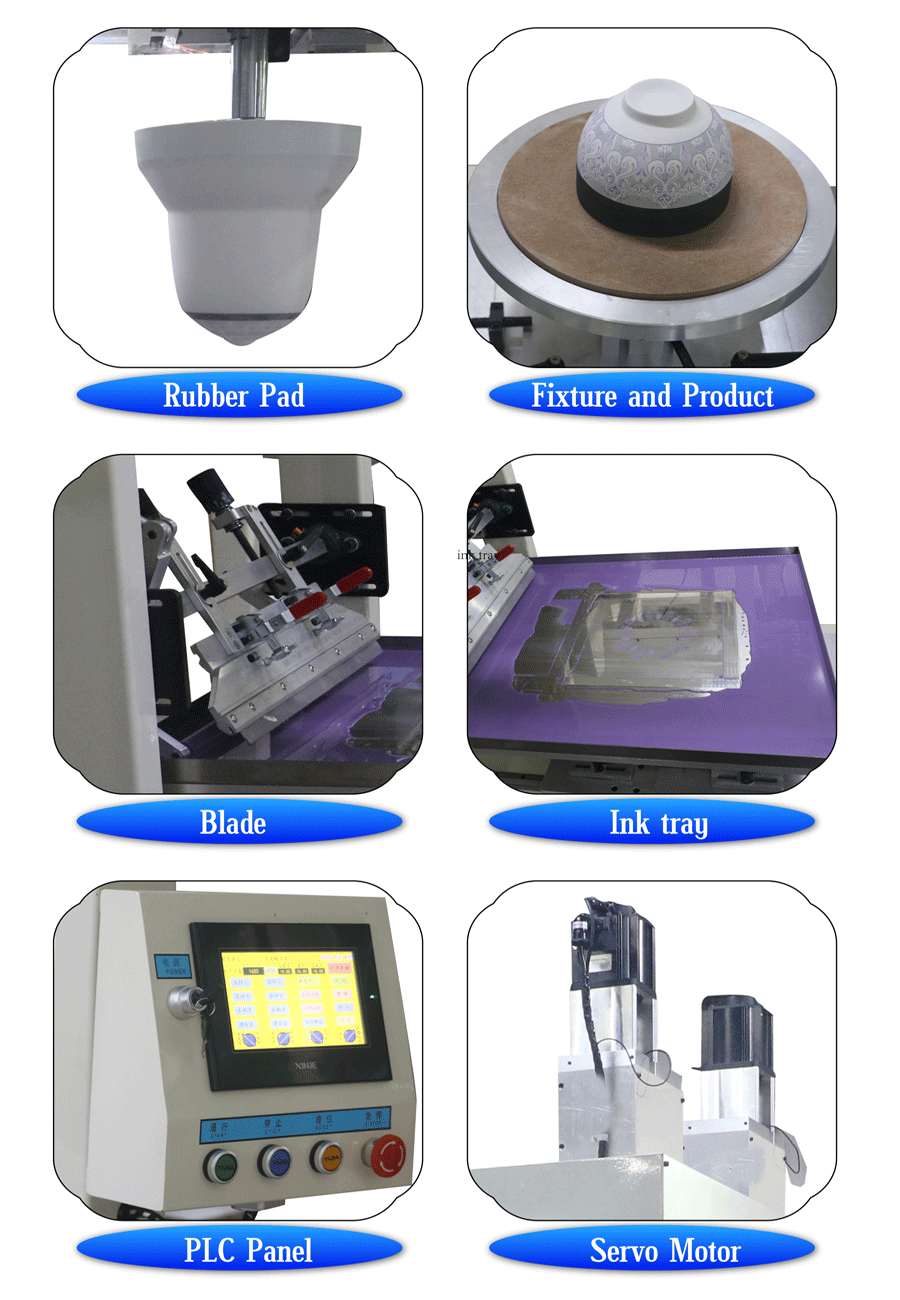
- Using the dimensional modulating table, can be up and down, front, left, and rotation of the adjustment, which will help precise printing;
- T-slot structure, easy installation of fixtures and products;
- Hand pick and place workpiece, operating more handy;
- PLC program control, the movement is more accurate and reliable;
- Servo Rubber pad system ;
- Open inkwell ink system;
- World famous pneumatic components to ensure the long service life of machine;
- Rubber sliding shaft with hardened guide shaft grinding of high hardness, good abrasion resistance;
- Auto balanced doctor blade ensures that ink can be scraped cleanly and completely.
How to overprint ceramic bowls?
When the ceramic pad printer is overprinting ceramic bowls, the following issues should be paid special attention to:
1. Uniformity of fixtures
The multi-color patterns to be overprinted need to be positioned with the same reference (such as the edge of the bowl mouth, the mark on the bottom of the bowl, or a special positioning hole). The fixture should be designed as "one-time clamping, multi-color sharing" to avoid position deviation caused by multiple clamping (the error should be controlled within 0.1-0.3mm). The surface of the ceramic bowl is smooth, and the fixture needs to be fixed with anti-slip materials (such as silicone pads), with mechanical limit or vacuum adsorption to prevent the bowl body from sliding slightly during printing (even a displacement of 0.5mm will cause overprinting misalignment). The X/Y axis movement accuracy and the rubber head rotation angle of the pad printer ensure that the workbench position and rubber head landing point are completely consistent during multi-color printing. The "cross line" calibration can be used to test print to observe whether the lines overlap.
2. Adaptability of rubber head
Multi-color overprinting requires the use of rubber heads of the same batch and consistent hardness. The diameter of the rubber head must cover the maximum size of the single-color block, and a 1-2mm margin must be reserved on the edge to ensure that the edges of adjacent patterns can be accurately connected when multiple colors are superimposed.
3. Ink Sequentiality
The ink of one color must reach a "non-sticky" surface dry state (which can be accelerated by low-temperature pre-baking, temperature 30-50°C) before the next color overprinting is performed to prevent the subsequent color ink from sticking to the previous color pattern. Multi-color inks must be of the same system (such as all overglaze color inks) to ensure that the shrinkage rate of multi-color inks is consistent during subsequent high-temperature baking (to prevent aggravation of overprinting misalignment).
4. Pattern Pre-deformation
When designing a pattern, adjacent color blocks can reserve an "overlapping edge" of about 0.1mm (to avoid white leakage due to slight misalignment), set an "overprint crosshair" or color block mark in a non-visible area (such as the bottom of a bowl), check the alignment of the mark through a magnifying glass during trial printing, and quickly adjust the equipment parameters (such as fine-tuning the X/Y axis position of the workbench).



