
Product
Product
Supplier
Search
Get Quote
730 people are quoting

6-BA 99% TC, also known as 6-Benzylaminopurine or benzyladenine, is a synthetic cytokinin plant growth regulator supplied as a technical raw powder for agricultural formulation and plant tissue culture applications. The material is standardized to an assay of not less than 99% by HPLC and appears as a white to off-white crystalline powder.
As a cytokinin-type plant growth regulator, 6-BA is primarily associated with regulation of cell division, shoot and bud development, lateral bud formation, and leaf senescence. Its physiological profile makes it relevant to formulations designed for vegetative growth management, reproductive-stage management, and controlled plant propagation.
Plant tissue culture is an important technical application for 6-Benzylaminopurine. It can be incorporated into culture media where cytokinin activity is required for shoot induction, bud multiplication, and regulation of the balance between shoot and root development. The appropriate concentration depends on plant species, explant type, culture stage, and other growth regulators present in the medium.
In agricultural formulations, 6-BA can be used in seed treatment, foliar application, flower and fruit management, and selected post-harvest or preservation-related programs where permitted. It can also be evaluated in compound plant growth regulator formulations containing gibberellic acid or brassinosteroid-type ingredients.
The technical material is practically insoluble in water. Appropriate dissolution, solubilization, or dispersion technology is therefore required when developing aqueous formulations. Because cytokinin responses are concentration-dependent, dosage and application timing require careful control.
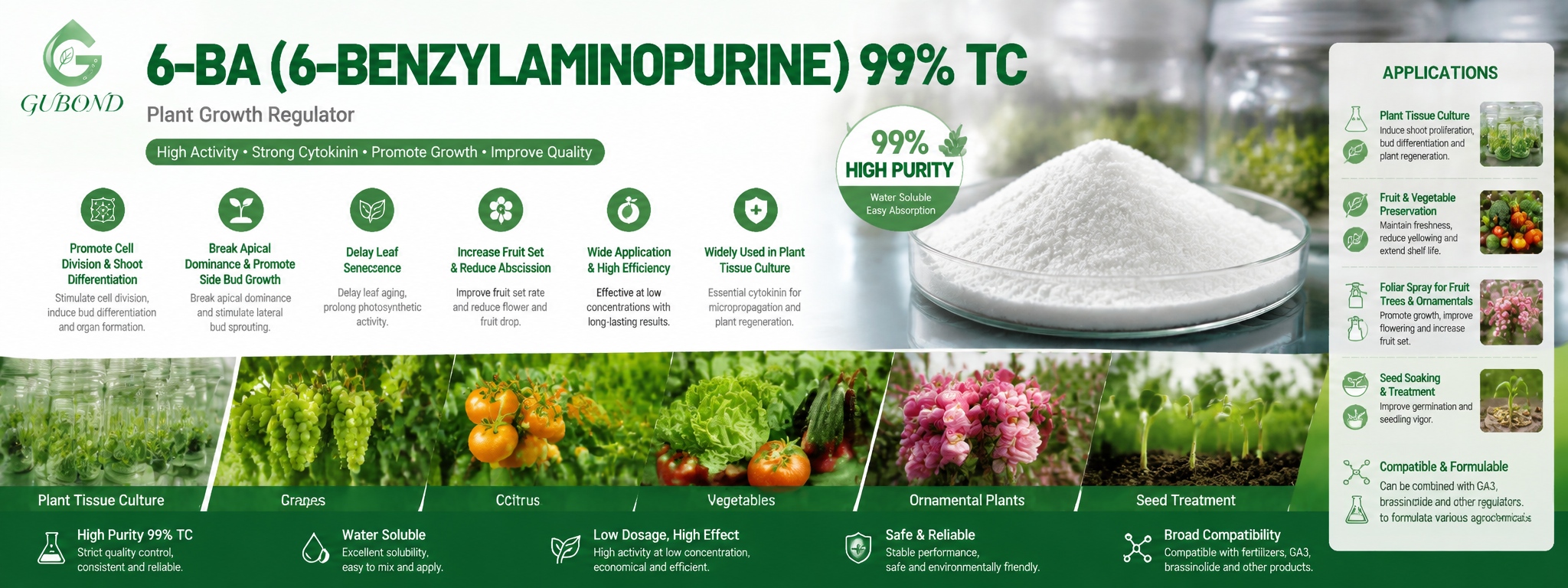
| Parameter | Specification |
|---|---|
| Product Name | 6-BA (6-Benzylaminopurine) 99% TC |
| Alternative Name | Benzyladenine |
| Chemical Name | 6-Benzylaminopurine |
| Product Type | Synthetic Cytokinin Plant Growth Regulator |
| Grade | Technical Grade |
| Form | Technical Raw Powder |
| Assay | ≥99% |
| Test Method | HPLC |
| CAS Number | 1214-39-7 |
| Appearance | White to Off-White Crystalline Powder |
| Loss on Drying | ≤0.5% |
| Residue on Ignition | ≤0.1% |
| Water Solubility | Practically Insoluble |
| Solubility | Soluble in Suitable Dilute Acid or Alkali Systems, and DMSO |
| Main Applications | Tissue Culture, Seed Treatment, Foliar Application, Flower and Fruit Management |
| Common Combinations | Gibberellic Acid and Brassinosteroid PGRs |
| Quality Documentation | COA / SDS Available |
| Storage | Cool, Dry, Shaded, and Sealed Conditions |
6-Benzylaminopurine is a synthetic cytokinin used to regulate cytokinin-responsive processes in plants. Its principal technical functions are associated with cell division, shoot development, bud differentiation, and regulation of plant senescence.
One characteristic of cytokinin activity is its relationship with apical dominance and lateral bud development. 6-BA can be incorporated into formulations or culture systems intended to modify shoot architecture and stimulate bud development. The actual response depends on crop species, developmental stage, endogenous hormone balance, and applied concentration.
6-BA is also relevant to leaf-ageing management because cytokinins are associated with regulation of senescence-related physiological processes. This property is considered in selected crop, ornamental, and post-harvest formulation contexts where such uses are permitted.
From a formulation perspective, low water solubility is an important consideration. The technical powder should not be treated as a directly water-soluble raw material. Suitable solvent, pH adjustment, solubilization, dispersion, or other formulation approaches may be required depending on the intended finished product.
The material can be evaluated for combination with gibberellic acid, brassinosteroid-type PGRs, and compatible agricultural inputs. Compatibility should be assessed using the complete formulation because active concentration, pH, solvent system, surfactants, and other components may influence stability.
Application concentration requires strict control. Excessive cytokinin exposure may produce undesirable morphological responses, including abnormal leaf or shoot development.
Plant tissue culture is one of the principal technical applications of 6-BA.
6-Benzylaminopurine can be incorporated into culture media to provide cytokinin activity during shoot induction and multiplication. It is frequently considered when the objective is to stimulate adventitious or lateral bud development and increase shoot proliferation.
The cytokinin-to-auxin balance is an important factor in tissue culture. Appropriate concentrations therefore depend on the plant species, explant, culture medium, propagation stage, and other growth regulators in the system.
6-BA can be used in plant growth regulator programs designed to influence bud differentiation and lateral shoot development.
By modifying cytokinin-related physiological signaling, formulations containing 6-BA can be applied in selected horticultural, ornamental, and fruit-crop production systems. Application concentration and timing should be established for the specific crop and intended response.
6-Benzylaminopurine can be incorporated into formulations intended for selected flowering, fruit-setting, and fruit-development programs.
Its use during reproductive development should be differentiated from that of auxins, gibberellins, or fruit-expansion PGRs because each class acts through different physiological pathways.
Crop variety, flowering stage, fruit-development stage, environmental conditions, and treatment concentration should be considered when establishing an application program.
6-BA may be incorporated into seed-treatment formulations where cytokinin-related regulation of early plant development is required.
The appropriate treatment concentration should be determined according to crop species, seed characteristics, soaking duration, and formulation type. Uniform distribution of the active ingredient is important because of the relatively low concentrations used in PGR applications.
6-BA can be evaluated in compound formulations containing gibberellic acid, brassinosteroid-type ingredients, or other compatible PGRs.
Gibberellins and cytokinins regulate different aspects of plant development, so combining them can provide a broader physiological formulation profile. However, the final response depends on the concentration ratio, crop stage, treatment method, and environmental conditions.
Physical compatibility, chemical stability, dilution behavior, crop safety, and regulatory requirements should be evaluated for each finished formulation.
Cytokinin-related regulation of plant senescence makes 6-BA relevant to selected post-harvest and preservation research or applications where such uses are permitted.
The suitability of 6-BA for a particular harvested commodity should not be assumed from its agricultural PGR function alone. Residue requirements, registered use patterns, treatment concentration, and applicable food regulations must be considered.
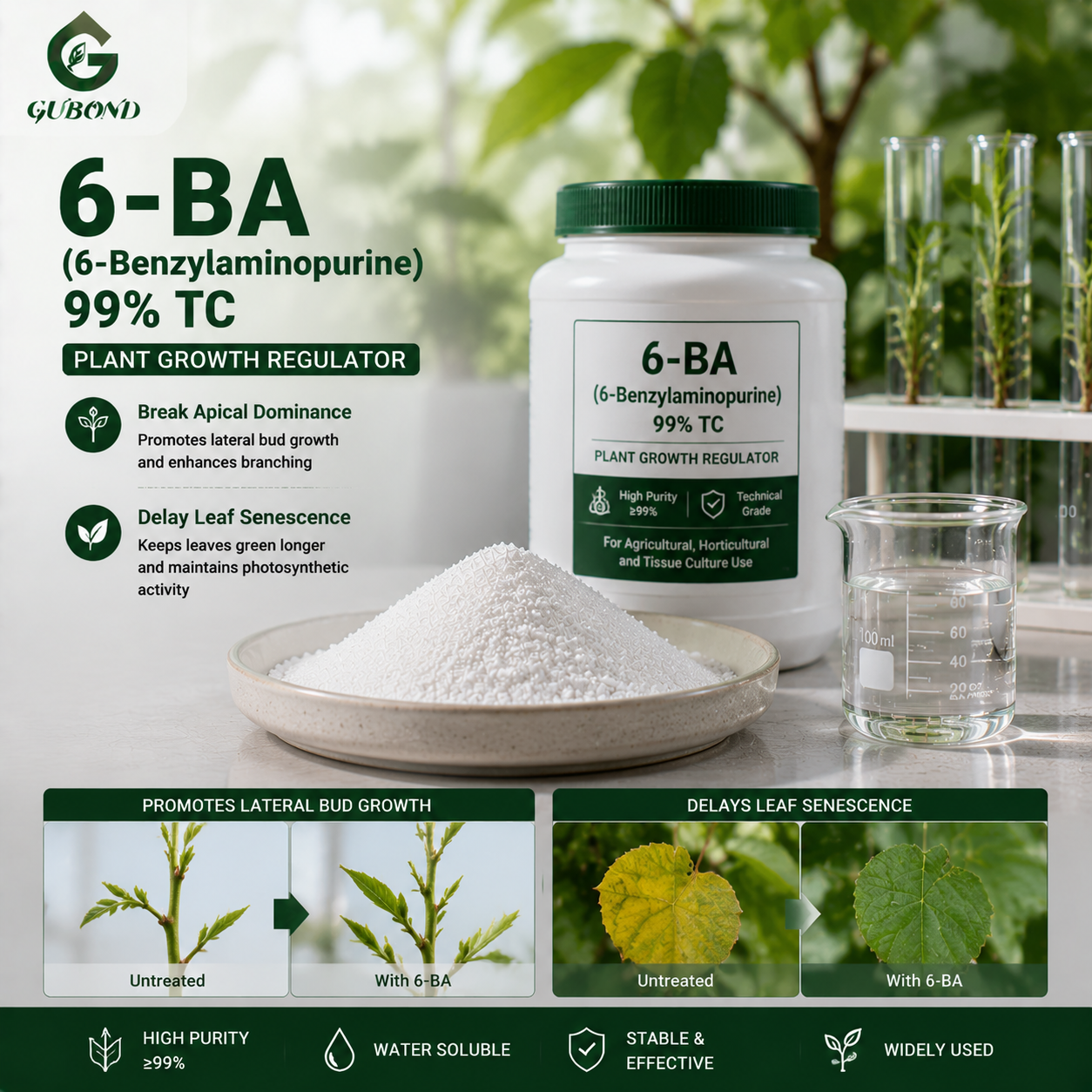
6-BA 99% TC is standardized to contain not less than 99% 6-Benzylaminopurine, with active content determined by HPLC. Loss on drying is specified at not more than 0.5%, while residue on ignition is specified at not more than 0.1%.
The technical material is supplied as a white to off-white crystalline powder. Its CAS number is 1214-39-7.
6-Benzylaminopurine is practically insoluble in water but can be incorporated into suitable solvent or pH-adjusted systems. Its solubility characteristics should be considered when developing liquid concentrates, water-dilutable products, or tissue-culture stock solutions.
Batch-specific quality parameters should be verified using the corresponding Certificate of Analysis. Safety and handling information should be reviewed using the applicable Safety Data Sheet.
The technical material should be kept in tightly sealed packaging under cool, dry, and shaded storage conditions. Excessive heat and unsuitable pH environments should be avoided.
6-BA 99% TC is a technical plant growth regulator material. Registration status, permitted crops, application concentrations, residue requirements, treatment methods, and labeling requirements vary between jurisdictions. Finished agricultural products should comply with the applicable regulations of the intended market.
If you are interested in the product, contact 2bvideo.com for more information for more information
The information of 2bvideo.com limited shown above is provided by the user or collected on the network. Video 2B does not guarantee the authenticity,accuracy and legitimacy of 2bvideo.com limited information. Video 2B does not involve legal relationships and disputes between users arising from transactions other than secured transactions on this website. Disputes shall be settled by you through negotiation. If you are the person in charge or relevant employee of this enterprise, if you find that the enterprise information is incorrect or want to manage thiscompany, please contact us jacklee1558@gmail.com, after you claim the enterprise, you can obtain management permission, publish supplyand demand information, bring consulting orders, and remove page advertisements.
Main Product:
Raw health products,
Food Additives,
Cosmetic Raw Materials,
Enzyme Supplements,
Protein Powder,
Health supplements


